
Whigs and me
Is a party that collapsed in the 1850s having a moment in the 2020s?

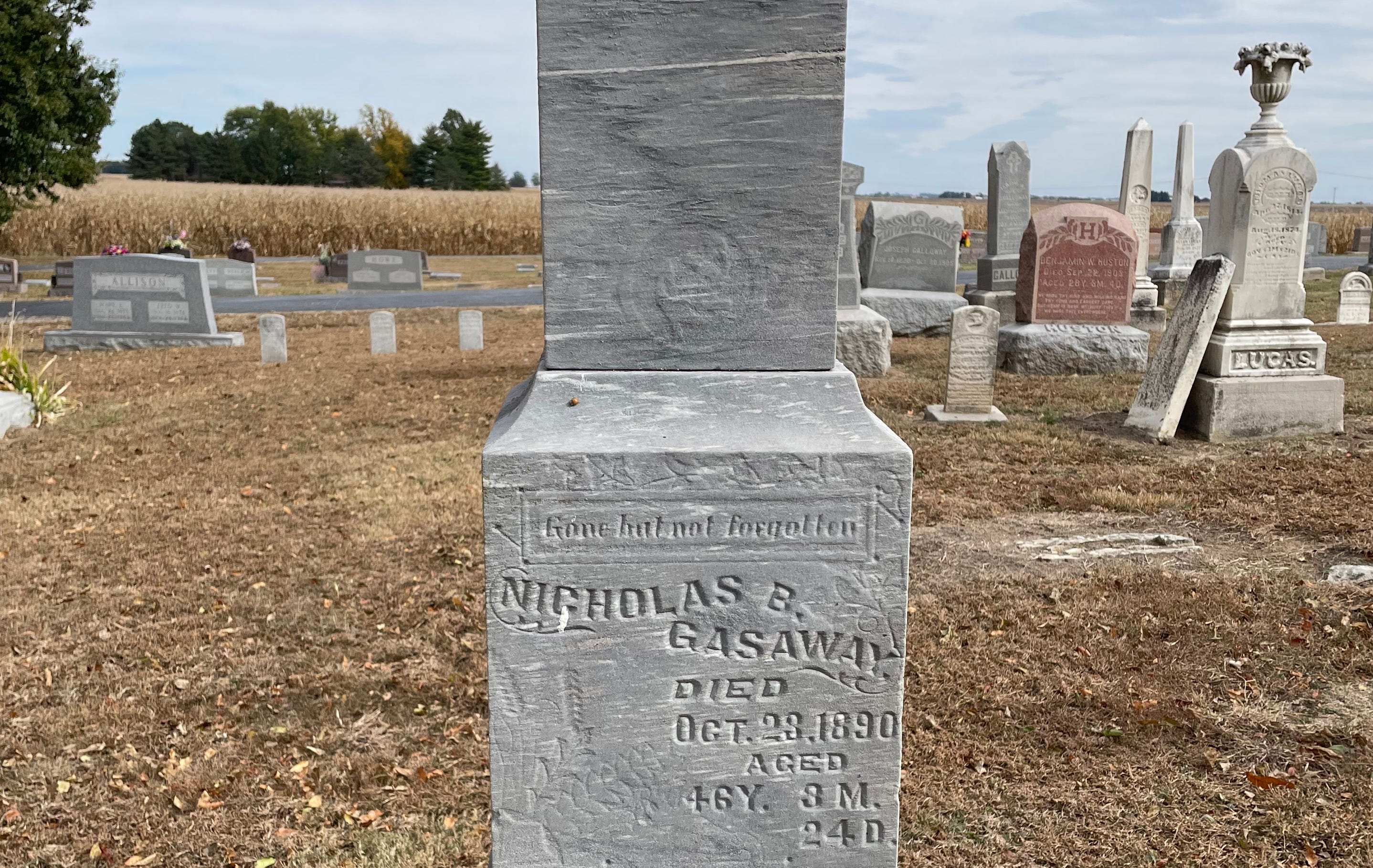
In our family’s genealogy the Gasaway branch loomed as a mystery. Relatives named Harms, Wallner, and Jones left the usual evidentiary bread crumbs. Gasaways eluded genealogical capture.
The trail stopped cold with my dad’s dad, and as children we were told our grandfather didn’t want to talk about it. My dad was an only child. I had a million Harms cousins and zero from the Gasaway side. There the matter rested.
Then Dad retired and got busy in the archives. He found his great-grandfather in a cemetery 35 miles from our house: Nicholas Biddle Gasaway.
How interesting, I said when Dad shared the news. I had just written a little something to bring down the curtain on grad school. The original Nicholas Biddle is a key supporting player in that narrative. I told Dad it would appear the Gasaways of yore were Whigs.
As head of the Second Bank of the United States, Nicholas Biddle fought and ultimately lost the so-called Bank War of the 1830s. The winner of said war was Andrew Jackson, the Democratic president.
Under the likes of Henry Clay and Daniel Webster, the Whig party rose from the ashes of the Bank of the US in opposition to Jackson. Two decades later the party dissolved in the fight over slavery’s expansion into the Kansas-Nebraska Territory.
In the 21st century one hears occasional calls for a return to Whiggery. “I’m a Whig,” conservative columnist David Brooks has written. Brooks credits the Whigs with seeking “to use limited but energetic government to enhance social mobility,” and has even referred to a “Whig-like working class abundance agenda.”
Historian Daniel Walker Howe famously summed up the party thusly: “As economic modernizers, as supporters of strong national government, and as humanitarians more receptive than their rivals to talent regardless or race or gender, the Whigs deserve to be remembered.” Whigs do deserve to be remembered, and some of their finest moments came before the name was even attached to the anti-Jackson party.
Bent on destroying each other, Jackson and Biddle were both rather heedless of the risks to the nation’s economy. During the “Panic Session” of Congress in 1833 brought on by the Bank War, one senator soon to align under the Whig banner presented a petition from the citizens of Richmond, Virginia.
In effect John Tyler said a pox on both your houses.
The memorialists look to Congress for relief. They ask not for a renewal of the Bank charter, but for the introduction of some stable financial system; not one depending on eccentric will; not a treasury resting on agents appointed by the president, liable to be displaced at his pleasure…but resting on law, not to be changed but for high reasons of state policy, approved by the wishes and sanctioned by the experience of Congress.
At their best Whigs upheld law, state policy, and experience in opposition to eccentric will. It was a laudable stance philosophically but politically the party was ill-starred. Both Whigs who won presidential elections — William Henry Harrison and Zachary Taylor — died in office. Democratic presidents following Jackson — Martin Van Buren, James Polk, and Franklin Pierce — were neither as eccentric nor as willful as Old Hickory. Whig opposition to “executive usurpation” seemed less urgent when confronted by Jackson’s successors than it had with the old hero himself.
The Whigs left behind a decent highlight reel, but we should harbor no illusions that today’s challenges map particularly well or even at all onto the late lamented party. For one thing Whigs were diffuse. The party embraced everyone from New England nationalists like Webster to southern fire-eaters spooked by Jackson’s triumph over South Carolina’s would-be secessionists in the Nullification Crisis of 1832-33.
If Whigs were economic modernizers they were also political luddites. They saw party caucuses, “partisan dictation,” and especially national conventions as nothing less than sinister. To Whigs it all smelled of Van Buren, the quintessential party pro. Entire states stayed away from the first Whig national convention in Harrisburg, Pennsylvania, in 1839. Whigs viewed conventions and platforms with the same disdain that hard-money Democrats held for banks.
Maintaining a broad coalition that was competitive in the South yielded outcomes reflecting little credit on Whiggery even in real time. This was an era when each Congress debated a “gag rule” to automatically table any and all abolitionist petitions. Though Whigs did number among their ranks abolitionists such as Vermont’s William Slade, other members felt the electoral need to prove their anti-abolitionist bona fides. The most restrictive gag rule of all was introduced in 1840 by Maryland Whig William Cost Johnson.
Basically there’s something discordant in mourning a party that imploded over slavery expansion. Surely it’s good that the newly minted Republican party which replaced the Whigs was unified in and indeed based on opposing expansion.
Instead of “I’m a Whig,” one might say “I’m an 1858 Republican.” Think Lincoln and the House Divided. The Republicans of 1858 were (mostly) Whigs, they too favored energetic but limited government, and they also harbored humanitarians in their ranks (see Lincoln’s takedown of the Know-Nothings in his letter to Joshua Speed). Only now their party wasn’t carrying all that factional Whig proslavery baggage.
Much of the Whigs’ appeal across time may come down to branding over substance. It sounds more erudite and interesting to proclaim oneself “a Whig” than to be a Republican from 1858 or indeed a Republican or Democrat from any epoch. In this sense ceasing to exist in the 19th century may have helped the Whig brand in the 21st.1
It turns out the party’s demise was still a decade in the future when my ancestor was named after one of the nation’s most prominent Whigs. Nicholas Biddle died in February 1844. My great-great-grandfather Nicholas Biddle Gasaway was born that June.
Alas, with all due respect to Nicholas Biddle Gasaway’s parents, I’m not a Whig. Indeed the Gasaway family tree is nothing if not scrupulously tripartisan. Ask me sometime about 1904 Democratic Vice Presidential nominee Henry Gassaway Davis.2
Possibly writers and speakers rather fancy writing and saying “Whig” because it denotes several different parties and ideas which all code as a bit obscure. In addition to the party of Clay and Webster, the Whig name graced a party in opposition to British Tories. American patriots in the Revolution were also referred to as Whigs, to say nothing of the “Whig interpretation of history,” or the claim that Aquinas was “the first Whig.” Republicans and Democrats can’t hope to compete in this space.
Davis was 80 when he captured the VP nomination in 1904, making him, by two years over Donald Trump in 2024, the oldest candidate ever nominated for national office by a major party. Our branch of the family also spelled the name Gassaway until 1780 and the birth of a trailblazer in Frederick County, Virginia, named John Gasaway.